
Trussville Previous Resident Sources
No single record lists every person who occupied a Trussville home. Deeds identify legal owners, parcel systems identify the current tax record, and directories or census schedules may identify previous residents who lived there. The most useful starting source depends on the time sought and the county that holds the parcel. Most Trussville addresses are in Jefferson County, but part of the city extends into St. Clair County. Verify that jurisdiction first.
| Source for past residents | Verified era | Where it is kept | Evidence supplied |
|---|---|---|---|
| Jefferson Landmark Birmingham index | Index 1987 onward; images 1993 onward | Jefferson County Probate Court | Transfers, mortgages, liens, and plats |
| Jefferson record room | Before web coverage; opening year not published | Birmingham courthouse | Direct and reverse indexes plus deed books |
| St. Clair parcel layer and Probate | Current layer; deed dates not published | County GIS and Probate offices | Owner, previous owner, last deed, sale, and title chain |
| Regional directories | Suburban 1965-94; metropolitan 1998-2004, with gaps | Alabama Archives and regional libraries | Listed residents and householders |
| Federal census | Public through 1950 | National Archives and library databases | People and relationships on census day |
| Sanborn volume 8 | 1930 through July 1950 | Library of Congress | Structure, material, use, and address context |
For recent ownership, begin with the parcel and deed. For a mid-century household, test the regional city directory and census together. For an older building, the recorded legal description may survive even when the street name or number does not. Trussville permits can add construction and occupancy chronology, but no public permit index or starting year was verified. Requests must use the exact situs address, meaning the address where the parcel physically sits.
Place Trussville Records by County
A postal address that says Trussville does not select the right courthouse. Jefferson County is the primary custodian for most local parcels, while an incorporated part of the city lies in St. Clair County. Start with parcel geography rather than the mailing city. In Jefferson, CAPture searches by name, parcel number, or address. The county GIS adds owner mail, situs, parcel ID, legal description, subdivision, block, plat book and page, municipality, and other mapped facts.
These fields play different roles. The situs points to the house. The owner-mail address is where the tax correspondence goes and may be elsewhere. Neither field proves every occupant. Once the county, parcel ID, and legal description agree, the previous residents search has a stable base that can survive a changed mailing format.
Note: Split a research log by county before following names; mixing Jefferson and St. Clair records can create a false chain.
Trace Trussville Ownership Records
Jefferson County's standard path is address to parcel, parcel to current owner and legal description, then owner to the acquisition deed in Landmark Web. The acquisition deed names the seller. Search that seller as a buyer in the older transaction and repeat. This creates the chain of title, the linked series of recorded transfers for the same real property.
- Confirm the current owner, parcel ID, legal description, subdivision, and deed reference in the assessor or GIS record.
- Find the current owner's purchase instrument in Landmark by name, book and page, instrument number, or legal details available in the index.
- Read the seller, who is the grantor, then search that person as the grantee in an earlier purchase.
- Repeat while the legal description and parcel facts still match. Record each date, instrument, book and page, and party role.
- When the web trail reaches its cutoff, continue in the Birmingham Probate record room's direct and reverse indexes and deed books.
Landmark's free tier displays index data and watermarked first or index pages. Registered small-volume users may buy full images for $2 per page; subscribers pay $125 per month plus $1 per page. The index is a courtesy aid, not the official record, and Probate does not perform a title search. Birmingham record-room help is available at 205-325-5512 or 205-325-5513.
- Grantor and grantee
- The grantor gives or sells an interest; the grantee receives it.
- Chain of title
- The sequence of recorded transfers linking today's parcel to earlier owners.
- Legal description
- The formal land description tied to plats, lots, blocks, or survey calls. It is steadier than a street label.
Previous Residents Before Landmark
A common mistake is to assume Jefferson County land records are online from 1965. That year applies to the Bessemer Division. Trussville ordinarily falls on the Birmingham side, where the online index begins in 1987 and document images begin in 1993. A blank web search before those dates does not mean no deed exists. It means the search must move to the direct and reverse indexes and deed books in the courthouse record room.
The names from the newest offline deed become the next search keys. Work backward while checking the legal description at each step. Old indexes may use initials, variant spellings, or a former subdivision description. If the street seems to break, compare the parcel ID and plat, then consult Birmingham Public Library's New-to-Old and Old-to-New street-name lists. No mass Trussville street-renumbering year was verified, so do not assign a date to a change without a plat or other record.
Cutoff check. For Trussville's Birmingham Division, online index data starts in 1987 and images start in 1993; older deeds remain an office search.
St. Clair Trussville Owner Records
St. Clair County offers a different bridge. Its public parcel layer exposes fields for current owner, previous owner, last-deed reference, sale date and price, subdivision, improvement year built, acreage, and parcel identifiers. Those fields can point toward the next instrument much faster than a bare address. They still do not replace the recorded deed.
No verified public St. Clair deed index was found, and the official assessment link was broken during inspection. Carry the PPIN or parcel ID, the current and previous owner names, last-deed reference, subdivision, and sale data to Probate. The Ashville Probate office can be reached at 205-594-2120 and the Pell City office at 205-338-9449. The office's grantor and grantee books continue the prior-resident trail when the map service ends.
Match Trussville Past Households
Owners are only one part of who lived here before. Birmingham Suburban directories cover verified editions from 1965 through 1994, and Jefferson County Metropolitan volumes cover selected years from 1998 through 2004. A criss-cross directory is arranged by street and number, making it useful for an address-led search. Exact Trussville coverage must be checked inside each volume. The Trussville city directory collections are detailed separately so the backward address trail can stay focused on occupants.
Pair those listings with the 1940 and 1950 federal census schedules when the era fits. Search names and address clues across both sources, then treat each match as dated evidence rather than a full address history. The method is a sequence, not a shortcut:
- Use a directory or telephone book to place a named person at the address in a narrow year.
- Check the nearest available editions on both sides and record every change in name or address.
- Locate the address or household in the 1940 or 1950 census and note each reported relationship.
- Compare the resident names with the deed owner. Keep an owner and an occupant in separate columns unless a source proves both roles.
- Use an obituary, probate file, cemetery record, or yearbook to explain a departure or identity change.
The Birmingham Public Library local databases include an ongoing Birmingham-area obituary index, Oak Hill interments, and a Jefferson Probate loose-record index for 1852 through 1936. The manifest capture below shows that local-history database gateway.
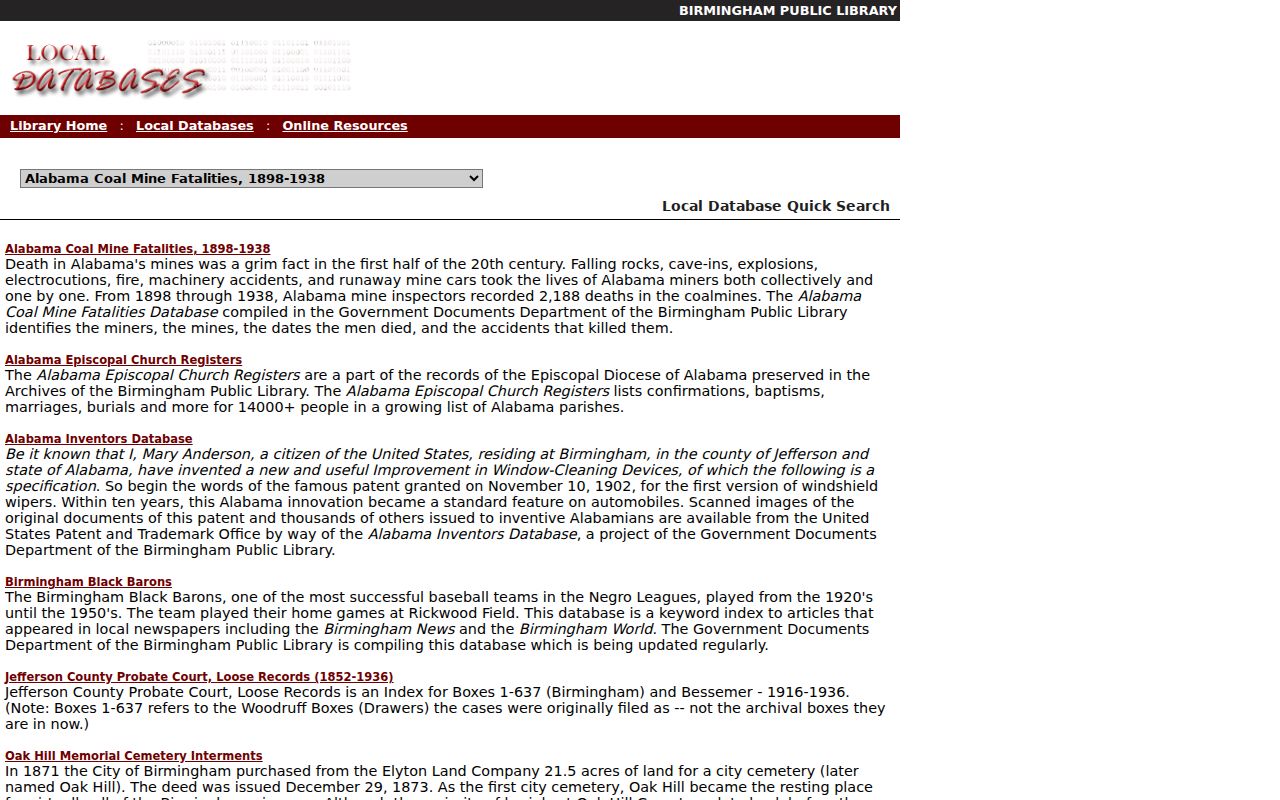
The database page is a practical end point for names that leave the deed or directory trail, especially when a death, estate, or burial may explain the change.
Date Trussville Address Records
The Library of Congress Sanborn catalog identifies Birmingham volume 8, dated 1930 through July 1950, with Trussville among the other places covered. Its 111 sheets can supply structure, building material, use, and address context. The catalog does not identify a stand-alone Trussville map, and the exact local sheets still must be found. Use it as a building-history source, not a resident roll.
Trussville permits can add a later construction trail. City files may identify the applicant, owner or contractor, work, plans, and chronology for construction, repairs, utilities, fences, pools, roofing, signs, and other projects. No public permit or code-case search exists. Send a narrow request by exact situs through the city public-document process. The form lists a $25 non-zoning retrieval charge, $0.25 per page, $10 certification, and $15 per hour or part after the first retrieval hour. It does not publish a submission channel or processing time, so call administrative offices first.
A permit applicant is not automatically a resident. Match the event date against the deed chain and directory timeline. A structure shown on a Sanborn sheet may predate the permit files that survive, while a later permit may explain a major change without identifying every person in the home.
Cahaba Trussville Resident Records
The Cahaba Project is Trussville's most important house-history exception. Federal planning created 273 residences from 1936 through 1938, and the first family arrived in May 1938. Early residents were tied to federal selection, rentals, school, and community records. After Trussville incorporated in 1947, federal park and water assets transferred in 1948 and the houses were sold. That shift moved the resident trail from federal tenancy toward private deeds and tax rolls.
For a Cahaba address, begin the earlier phase with project history, regional directories, school materials, photos, and any Trussville Library Archives material that can be confirmed. Begin the post-sale phase with deeds and assessments. Do not force one uninterrupted ownership chain across years when the record system itself changed. That local break can explain why the first private deed is much newer than the structure.
Hewitt-Trussville yearbooks, including digitized Memento 1965, and Jefferson school staff directories from 1950 through 1976 can resolve names connected to these homes. Obituaries and probate files may close the last link. These sources document people at points in time, but they do not make a complete roster of every past resident.
Lawful use. Research previous residents for family or house history, and never use an address trail to track, threaten, or harass a living person.
Note: Preserve the source and date beside each name so later researchers can distinguish proof, a strong clue, and an unresolved gap.