
The Trussville Directory Shelf
No authoritative catalog identifies a stand-alone run devoted only to Trussville. The useful directory collections are regional. A researcher must choose the edition that was likely to include the community, check its scope, and then confirm that the target name or street is present. The strongest verified holdings sit at the Alabama Department of Archives and History, while Birmingham Public Library adds an older and broad regional shelf. The table separates the runs so a missing name is not mistaken for proof that a person had left town.
| Trussville-area collection | Verified years | Repository | Access path |
|---|---|---|---|
| Birmingham Suburban | 1965-69, 1971-80, 1982-84, 1989, 1991-94 | Alabama Department of Archives and History | Repository holdings |
| Jefferson County Metropolitan and supplement | 1998 | Alabama Department of Archives and History | Repository holdings |
| Jefferson County Metropolitan | 1999, 2001-04 | Alabama Department of Archives and History | Repository holdings |
| Birmingham city directories | Selected years from 1888 through July 2007 | Alabama Department of Archives and History | Repository holdings; confirm Trussville scope |
| Birmingham Metropolitan telephone white pages | June 1974 and June 1975 | Library of Congress | Telephone-directory collection |
The Alabama Archives city-directory finding aid gives the exact runs. Birmingham Public Library says its local shelf begins in 1883 and continues to the present, though fragile books may be served on microfilm. Access can therefore mean a repository visit, a microfilm reader, or a digital institutional collection. Confirm the specific volume before making the trip.
Why Trussville Directories Are Regional
Trussville sits northeast of Birmingham, and its older resident trail was often published as part of a wider market. Early Birmingham publishing included Chas. W. Anson & Co. in 1887 and R. L. Polk's Birmingham, Suburban & Bessemer Directory in 1888. Later catalog records distinguish Birmingham city books from Birmingham Suburban and Jefferson County Metropolitan editions. That distinction is vital. A Birmingham book may be broad, yet its title alone does not prove that Trussville names appear inside.
Start with Birmingham Suburban for a Trussville person in the late twentieth century. Check the volume's community list or front matter before the alphabetical pages. If the target is absent, try the prior and next available editions, then test a metropolitan volume. This sequence guards against an omitted year, a name variant, or a household that was simply unlisted.
Research tip. The Birmingham Suburban run is the first Trussville city directory stop; Birmingham city volumes are a broader second check.
Trussville Directory Research at BPL
The Birmingham Public Library Southern History collection adds far more than bound city directories. Its holdings include family files, clipping files from the 1930s through the early 1980s, maps, newspapers, yearbooks, photos, and New-to-Old and Old-to-New street-name lists. In-library Ancestry is free at every BPL location, and Fold3 is among the genealogy tools. These companion sources help when a directory name is hard to read or an address seems to vanish.
The library describes an archive of more than 30 million documents and about 500,000 photographs. A directory result can thus become a route into a news clipping, school image, or map. The image below comes from the library's genealogy source identified in the manifest.
Visit the BPL genealogy collections page before planning a Trussville directory search.
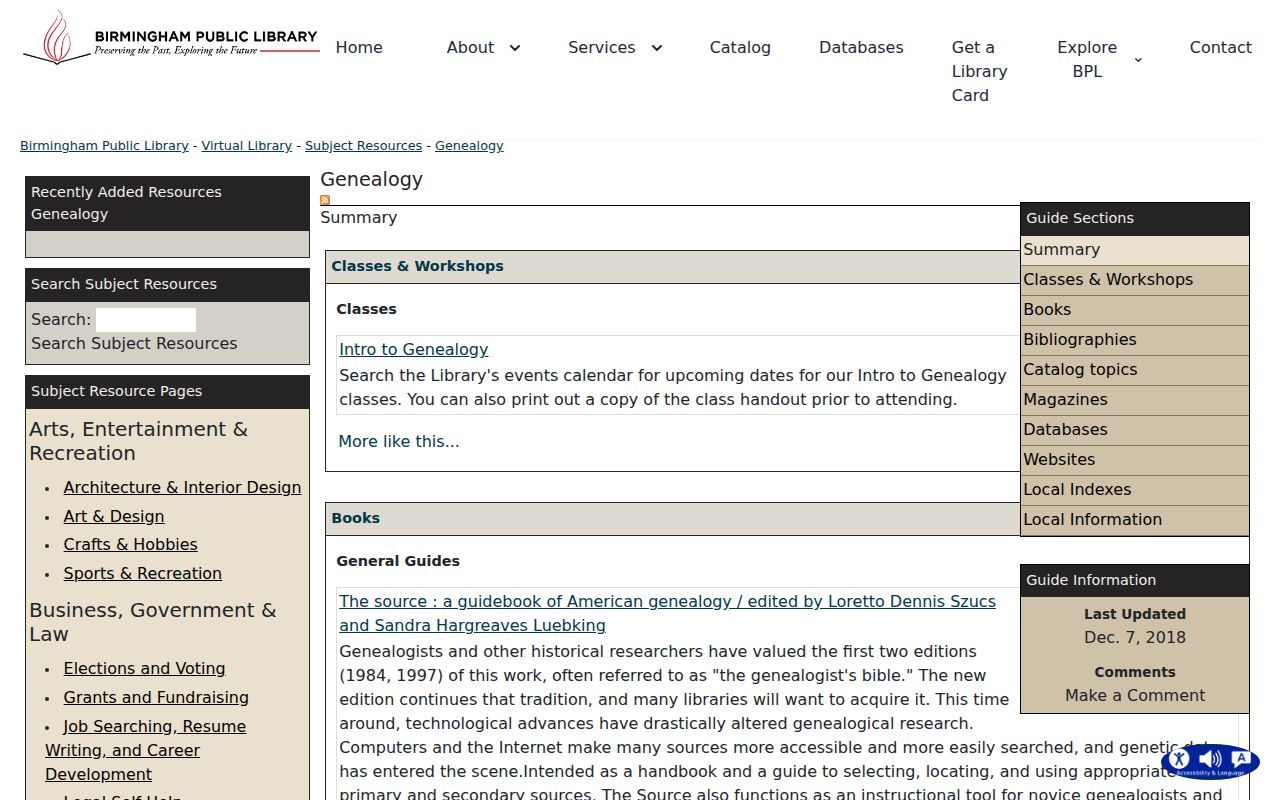
The captured page shows the library gateway that connects regional directory work with its larger Southern History resources. Trussville Public Library, at 201 Parkway Drive and 205-655-2022, also has an Archives used for Cahaba Project research, but no verified public inventory lists its directory years or reverse-directory holdings. Call before relying on a particular title.
Note: Repository catalogs establish holdings, while each volume's own scope decides whether a Trussville name should appear.
Decode a Trussville Directory Entry
A typical Polk entry may contain a surname, given name or initial, spouse notation, trade, employer, residence, and marks for owner, renter, or widow. Those are expected elements, not a transcription of a known Trussville entry. No open institutional viewer produced a sample local listing during research, so exact abbreviations must be read from the key printed in the volume being used.
| Resident name | Alphabetical identity, often shortened to initials |
|---|---|
| Spouse notation | A linked household clue whose style varies by edition |
| Work line | Trade or employer, when the publisher collected it |
| Residence | The street location printed for that edition |
| Status marks | Possible owner, renter, widow, or other coded notation |
Photograph or note the abbreviation key first. Then preserve the full line, page number, book title, and year. A clipped name without those facts is hard to verify later. Compare the alphabetical result with the street section where one exists, since the two arrangements can expose spelling or indexing mistakes.
- Criss-cross directory
- A directory arranged by street and house number, useful when the address is known but the name is not.
- Householder index
- An address-led or street-led section that points from a home to the listed person.
- Abbreviation key
- The volume's own legend for shortened words and status marks. Its meanings control that edition.
Trussville Directory Gaps Matter
Birmingham Public Library records four years with no published directory: 1933, 1936, 1943, and 1945. The gaps reflect Depression and wartime conditions, not four mass departures from Trussville. This is an easy trap. A person seen in 1932 and again in 1934 may have stayed at the same address despite the absent 1933 book.
The larger run also has irregular intervals. ADAH lists selected early Birmingham holdings, later city books, suburban volumes, and metropolitan editions rather than one perfect annual sequence. Always distinguish “not listed,” “volume not held,” and “no directory was published.” Those statements mean very different things in family research.
| 1883 | BPL says its Birmingham directory holdings begin |
|---|---|
| 1933 and 1936 | No directory was published during Depression-era gaps |
| 1943 and 1945 | No directory was published during wartime gaps |
| 1965-94 | Verified Birmingham Suburban editions, with gaps |
| 1998-2004 | Verified Jefferson County Metropolitan editions, with gaps |
Trussville Telephone Directory Years
The Library of Congress catalog identifies Birmingham Metropolitan white pages titled through Leeds to Trussville for June 1974 and June 1975. These telephone books are useful address-reversal companions. They can place a listed subscriber at a street address during a narrow month, but they are not full household rolls. A child, relative, unlisted subscriber, or person without the listed line may never appear.
Search the Library of Congress telephone-directory collection by place and date. Record the title as cataloged, since “Leeds to Trussville” is the key scope clue. Compare a white-page result with a suburban directory from the same period. The latest public federal census is 1950 under the 72-year rule, so later household confirmation needs deeds, obituaries, probate files, yearbooks, or other dated sources.
Cahaba Changes Trussville Records
The Cahaba Project creates a local break in how resident history should be read. Federal planning produced 273 residences from 1936 through 1938, and the first family arrived in May 1938. Before the homes became private property, tenancy and community records can be more useful than a normal deed chain. Trussville incorporated in 1947. Federal park and water assets transferred in 1948, and houses were sold, shifting the trail toward private deeds and tax rolls.
This transition explains why one source cannot follow a Cahaba household through every era. For the federal-rental phase, use community history, school publications, photographs, and regional listings. After sale, deeds and assessments become central. The Trussville Library Archives is a logical local contact for Cahaba research, while Birmingham repositories supply directories and wider context.
School material can fill another gap. Digitized Hewitt-Trussville yearbooks include Memento 1965. Jefferson County Board of Education directories from 1950 through 1976 list teachers by name, address, and school, along with administrators and calendars. These sources can resolve an initial, reconnect classmates, or explain why a name appears near Trussville but not in a city directory index.
Trace Trussville Families by Directory
A directory match becomes reliable when it survives checks across adjacent years and another type of record. Begin with the likeliest regional edition. Follow the name in both directions, note each address change, and keep every spelling variant. Then connect the result to a census, obituary, probate index, deed, yearbook, or school directory. The BPL local databases include an ongoing Birmingham-area obituary index, Oak Hill interments, and a Jefferson Probate loose-record index covering 1852 through 1936.
- Choose Birmingham Suburban, Jefferson County Metropolitan, or the broader Birmingham run based on the target year.
- Check the edition's scope, then search the surname, initials, spouse notation, and common variants.
- Compare the prior and next available books. Mark moves, first appearances, and last appearances without assuming what caused them.
- Use a street or householder section, when present, to test the address and nearby listed households.
- Pair the trail with the 1940 or 1950 census, then test deeds, probate, obituaries, yearbooks, and school directories.
A person who disappears may have moved, died, changed a name, become unlisted, or fallen into a publication gap. An obituary or probate file can close one branch. A deed may explain an address change without proving who occupied the house. For a modern address-led search, the Trussville street directory keeps parcel ownership separate from household evidence.
Note: Treat every directory line as a dated clue, not as proof of all people who lived in the home.